
Ingredient guide
What is PHGG soluble fibre? A plain-English guide
What PHGG, or partially hydrolysed guar gum, is, how it behaves as a soluble fibre, and how DAILY brings it to the meals you already eat.
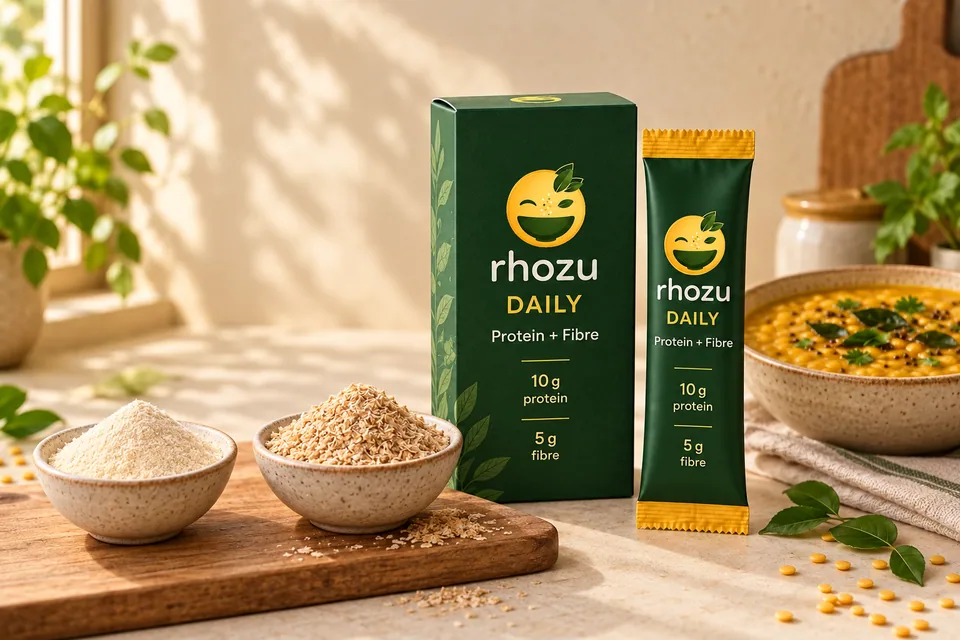
PHGG in plain English
PHGG stands for partially hydrolysed guar gum. It is made from guar and is used as a soluble dietary fibre. In practical terms, it is a fine plant-derived fibre that can be stirred through moist food.
PHGG is also fermentable: gut microbes can use it after it reaches the colon. In DAILY, it is the soluble-fibre ingredient that brings a measured fibre portion to the meal.
Soluble fibre in a real meal
A soluble fibre can disperse in liquid, but a complete meal mixture is not necessarily clear or unchanged. DAILY also contains plant-protein particles. The food, its moisture and the thoroughness of stirring all affect thickness and texture.
For that reason, the useful test is a properly mixed, full portion of food—not a dry spoonful or a small amount of liquid. Start with a meal you already know and can eat promptly.
What the research tells us
A 2005 randomized open trial compared 5 g and 10 g per day of PHGG ingredient in adults with irritable bowel syndrome. It studied that ingredient, dose and population; it did not test RHOZU DAILY, its protein blend or its meal format.
A 2019 study also shows why ingredient mass and dietary-fibre assay should be read on the same basis. Together, these papers explain PHGG as an ingredient; DAILY adds its own defined blend, serving and meal method.
How DAILY uses PHGG
Each DAILY sachet provides 5 g dietary fibre alongside 10 g plant protein. Add one sachet after cooking to roughly 200 g or more of moist food such as dal, sambar, khichdi, curry or curd. Sprinkle gradually and stir thoroughly through the whole portion.
Start with one sachet daily for at least seven days. Only increase to two daily if comfortable, one with each of two meals. Stay at one for longer if needed; do not increase while symptoms persist.
Make DAILY your own routine
DAILY is for adults and contains mung bean, a legume. Read the ingredients if allergies are part of your routine. Kidney disease, a prescribed protein restriction, phenylketonuria, levodopa or levothyroxine therapy are all good reasons to take the exact label to your clinician or prescriber.
Begin with the stated one-sachet routine and adjust only when it suits you. Persistent or severe symptoms belong with a healthcare professional.
Ready for the simpler routine
10 g protein + 5 g fibre, right in your meal.
DAILY is an unflavoured plant-protein and PHGG fibre sachet made for moist food after cooking. One measured portion. One familiar meal.